Here’s what my readers are saying: Here’s what they have said about ‘Seven C’s to Calm’:
If you suffer from anxiety it is quite likely that along with the discomfort of the anxiety itself, you have also been working hard to keep it top secret.
In this competitive world of ours, we do all we can to keep the bright side out, to look our best and be strong. Appearing weak and vulnerable doesn’t seem to fit with the way of things. Yet, sometimes by exposing that very part of ourselves we actually grow stronger.
More and more people (including myself), are calling it out that they have suffered mental anguish and despite this they have managed to overcome all sorts of trials. Our stories of triumph over anxiety contribute to the ending of stigmas and inspire others to take action to seek an improved life experience.
Anxiety is actually more like a learned behaviour, habit or response to something that has caused trauma at some point in our lives, particularly at an early age when we are most susceptible and lacking in knowledge.
It’s suggested in some circles that being of a more sensitive disposition makes us more susceptible to anxiety. I am of the opinion that without role models to show us that sensitivity is actually a strength and not weakness we may fool ourselves to thinking it’s all our own fault and not much we can do. We owe it to each other to be that role model. Recovery from anxiety is possible whether you have the gift of heightened sensitivity or not.
Some amount of anxiety is normal and, similar to fear, it alerts us to take stock of something or pay attention in certain situations. Messages we pick up through our environment, combined with thoughts/stored memories can lead to sensations in our body, triggered by our nervous and endocrine (hormonal) systems.
Adrenaline is one of the notable hormones being released into our blood stream when we are anxious. The term ‘fight or flight’ is used to describe how adrenaline prepares our body when we feel there may be some threat or danger imminent e.g. delivering more glucose and oxygen to specific sites such as muscles to help us move faster by generating more energy.
Anxiety (including panic attacks and phobias) however can be triggered when there is no apparent threat. Parts of our brain (e.g. the limbic system) house an extensive record of stored memories, for comparison purposes, with our on-going life experiences. If a significant match is found in these records, suggesting something in our current environment is not good for us or may cause a problem then the stress response is likely to be triggered.
When anxiety is constantly being triggered you are effectively ‘leaking adrenaline’ into your system. Left unattended, this constant excess of adrenaline has consequences for our long-term health and well-being.
Energy level, sleep quality and concentration are all set to suffer. There can be consequences too for creating imbalance in our endocrine system, as hormones affecting fertility and digestion are impacted by excess amounts of adrenaline.
Another detrimental factor of prolonged anxiety (especially if it presents as panic attack or phobia) is the avoidance of places, situations and people. This in turn can lead to restricted life experiences which can impact our self-esteem and mental health by cutting off some of our basic needs which are obtained from social engagement and personal relationships.
"Seven Cs to Calm is a good investment for people who want to restore calm and experience life with more purpose and joy."
Caroline Cunningham Author & Authentic Path Coach
I wrote ‘Seven C’s to Calm – Reclaiming your anxiety-free self’ to provide support and encouragement for people who are suffering with anxiety and especially for those of you who do not know where to start.
In this little book, I share insights and tips that I’ve learned from my 20 years+ of personal experience and study, which have empowered me to live with greater authenticity and wellbeing.
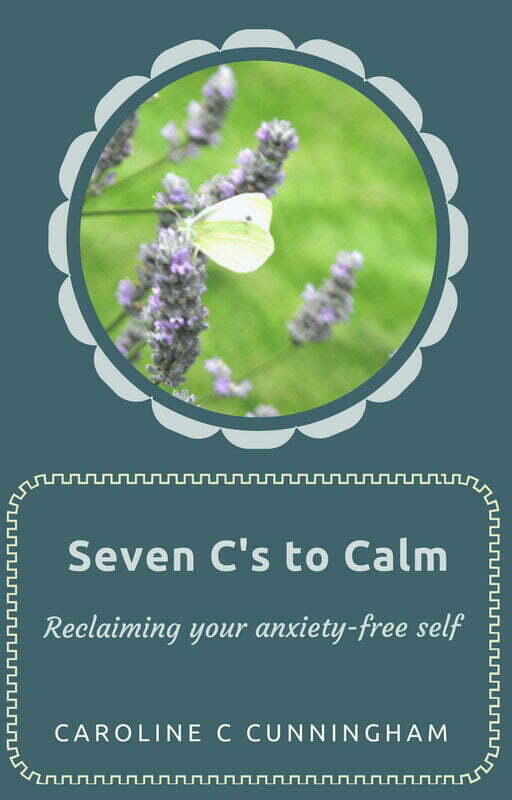
My readers have given Seven C’s to Calm a resounding thumbs up for its effectiveness and no-nonsense approach.
Transforming your life is possible at any age, my own journey is a testimony to that. I believe authenticity and wellness are intrinsic to success in all areas of life. It takes courage and passion and they are within you, waiting to for the spark to set them alive. When you read my posts I hope you will get sense of my capacity to help you to succeed with your dreams and goals. Check out my books, online courses and personal wellness programmes designed to guide you towards the most powerful authentic version of yourself. Learn more about my journey here.
Here’s what my readers are saying: Here’s what they have said about ‘Seven C’s to Calm’:
"She still had that extra-ordinary glow and wisdom shining through her eyes, just as artist Helen Mable Trevor had captured." I made many interesting discoveries during my lunchtime visits to the gallery. I found out that William Dargan (1799-1867), the great Irish railway magnate, was originally from Carlow, my home county. Also, George Bernard Shaw […]
Good fortune is something we can attract by our own good deeds and earnest work. Some experiences however, impress upon us the importance of never taking our good fortune for granted. Thats why I feel gratitude is so important. Today I express gratitude for some of the very supportive networks that surround me off-line and […]